High-net-worth individuals and families seek stability, favourable taxation and top-tier services—particularly in education and mobility. Naturally, they also look for exclusive properties in prime locations, offering every comfort and representing sound strategic investments. These criteria explain why Switzerland has become the preferred “home” for the world’s wealthiest taxpayers. Among the most sought-after areas are Lugano and Locarno, with their iconic lakes.
Despite being landlocked, Switzerland remains the safe haven par excellence—not only for its currency, but also in times of global uncertainty and geopolitical tension. The country continues to offer a uniquely attractive framework: clear regulations, inflation and interest rates under control, and a long-term political and economic vision. Located at the heart of Europe, Switzerland has established itself as an international hub for strategic sectors such as finance, luxury and diplomacy—a tradition that continues today in Geneva.
“In times of geopolitical tension and increasing fiscal pressure, many high-income families choose Switzerland not only to protect their wealth, but also to raise their children in a secure environment with access to a high-quality education system,”
notes Quentin Epiney, Founder and CEO of FGP Swiss & Alps.
Specialised in the intermediation of prime residential properties, FGP Swiss & Alps exclusively represents Forbes Global Properties in Switzerland and the French Alps. The network is a global benchmark for the world’s most exclusive real estate and FGP Swiss & Alps is one of its founding members.
A dynamic luxury market
Over the past few years, the Swiss luxury real estate market has gone through several phases. Following post-pandemic euphoria—characterised by strong demand in both urban centres and ski resorts, with rising prices and transaction volumes—the market entered a seller’s market phase, leading to price stabilisation or slight corrections. Today, amid renewed international instability and declining interest rates, market momentum is accelerating once again.
Looking at its client base, Epiney confirms that the average buyer is relatively young, typically between 30 and 50 years old, in a phase of professional or family growth.
“Buyers are looking for more space or have greater financial capacity, allowing them to target larger properties. Some are seeking a trophy asset, others a strategic investment or portfolio diversification. Sellers, on the other hand, tend to be more mature—around 55 years old—and are often in a downsizing phase,”
explains Epiney.
In recent years, Switzerland has seen a significant influx of American families with teenage children, attracted by the country’s outstanding education system. There is also strong demand from French families, particularly in the Geneva region, drawn by favourable tax conditions. In these cases, average budgets frequently exceed CHF 20 million.
Prices in the Geneva area are largely driven by senior executives and traders from major commodity companies—often foreign nationals resident in Switzerland—who acquire properties valued between CHF 50 and 60 million, financed by multi-million-franc bonuses. Swiss nationals and long-term residents—managers, entrepreneurs, lawyers, bankers and C-level executives—typically operate within more moderate budgets, up to CHF 15 million.
Key geographic hubs
Beyond Geneva, demand is concentrated around Zurich, with its financial centre and lakeside lifestyle, particularly attractive to German and Northern European clients. Central Switzerland—Zug and Schwyz—also stands out for combining tax advantages with exclusivity. Prime alpine resorts remain evergreen: St. Moritz, Verbier, Zermatt and Gstaad, where prices have reached record levels of CHF 100,000 per square metre.
From contemporary architect-designed lakefront homes to historic estates, luxury chalets and high-end second residences, FGP Swiss & Alps’ portfolio is designed to meet the expectations of the most discerning clients.
What ultra-high-net-worth buyers are looking for
“The first requirement today is services,”
says Epiney.
“Private spas, swimming pools, fitness rooms and cinemas are increasingly expected—both in cities and in ski resorts. What was once exceptional has become the norm in luxury properties.”
This is followed by location, views and space. Lakefront properties are a clear trend, as are panoramic Alpine views in mountain resorts. For both Swiss buyers and international relocations, proximity to workplaces, international schools, highways and airports is crucial. Since the pandemic, demand for private outdoor space has also increased significantly—even in urban environments.
The diversity of properties brokered by FGP Swiss & Alps reflects these preferences: from the historic grandeur of Villa Fleur d’Eau in Versoix—designed in Second Empire style for banker Vernes d’Arlandes and the site of pivotal diplomatic meetings such as the 1985 Geneva Summit between Reagan and Gorbachev—to contemporary architectural masterpieces.
Emerging destinations: the case of Grimentz
FGP Swiss & Alps also continues to identify new opportunities. One example is Grimentz, an emerging Alpine destination in the canton of Valais. Ranked by CNN among the three most beautiful Alpine villages in Europe and named the best family ski resort in the Alps by National Geographic, Grimentz also features in the Financial Times’ top 20 ski resorts worldwide for snow reliability.
With average annual value growth of 6% over the past decade, prices remain relatively accessible compared to more established resorts.
“We are talking about prices between CHF 12,000 and CHF 15,000 per square metre for projects developed both by FGP Swiss & Alps and by our parent group, Comptoir Immobilier,”
explains Epiney.
Grimentz is located at the heart of the “Couronne Impériale,” surrounded by five of Switzerland’s most iconic 4,000-metre peaks, and is one of only four resorts where helicopter access is permitted—including for heli-skiing. Importantly, thanks to building permits predating the Lex Koller and Lex Weber restrictions, certain properties remain accessible to foreign investors.
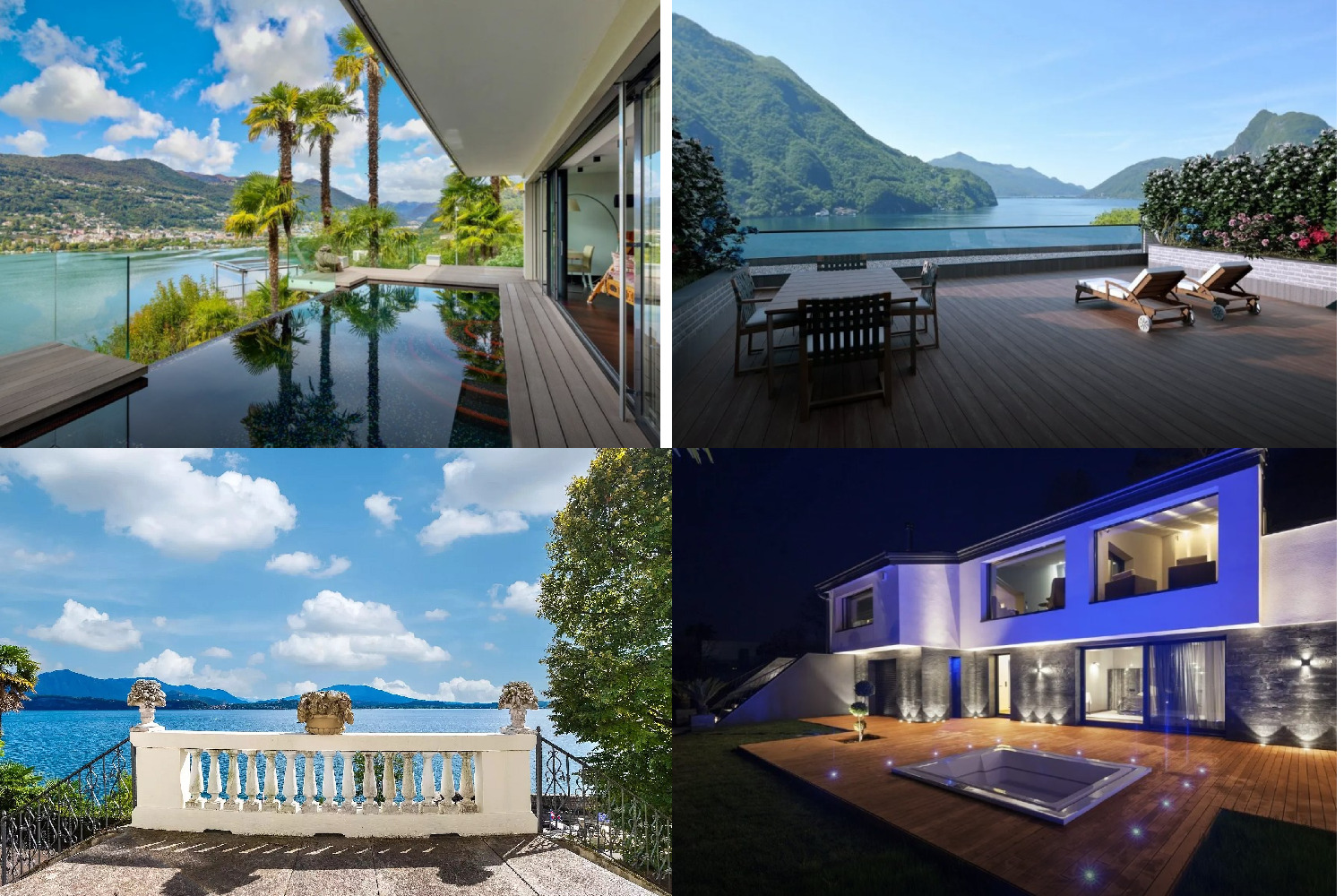
Wealth concentration in Ticino
Beyond new destinations, wealth in Switzerland remains concentrated in a limited number of hubs. A recent study by Brillhart & Partners Luxury Real Estate confirms that Ticino follows the same clustering pattern, with two main high-income areas: the Lugano region and the Locarno region.
“Once again, proximity to the lake plays a fundamental role,”
explains Daniele Mantegazzi, Property Market Analyst at Brillhart & Partners.
Ticino mirrors the national share of taxpayers earning over CHF 2 million annually—0.03% versus 0.04% nationwide. However, when considering incomes above CHF 100,000, a structural gap emerges compared to the rest of Switzerland, highlighting the need to strengthen wage growth to remain attractive to affluent taxpayers.
Property data confirms that “wealth attracts wealth.” Around Lake Lugano (Porza, Collina d’Oro, Sorengo, Lugano) and Lake Maggiore (Ascona, Minusio, Locarno), median local incomes are high, indicating the appeal of prosperous communities offering a specific lifestyle context. These areas also show a higher proportion of foreign residents and larger families.
Luxury real estate transactions in Ticino have tripled in both volume and value since the late 1990s. While local buyers still represent the majority, they are gradually declining in favour of buyers from other cantons and abroad. Foreign buyers, although fewer in number, acquire the most expensive properties.
Peak prices currently reach CHF 18,000 per square metre for luxury villas and apartments in Lugano-Castagnola and Ascona. In early autumn, the most expensive villa and apartment for sale in Ticino were both located in Porza, priced at CHF 28 million and CHF 12.5 million respectively.
A strategic asset to preserve
Switzerland currently leads the global ranking in millionaire density, with 145.6 millionaires per 1,000 adults—well ahead of Hong Kong, Australia and the United States. A level of prosperity that represents a strategic asset to protect.
The real estate arm of a global media powerhouse
Founded in 2020, Forbes Global Properties brings together the expertise of leading luxury real estate firms worldwide, combined with privileged access to Forbes’ global audience—over 140 million people reached monthly through its digital ecosystem and 5.7 million magazine readers. FGP Swiss & Alps, the exclusive representative of Forbes Global Properties in Switzerland and the French Alps, is a subsidiary of the Comptoir Immobilier Group, the leading real estate group in French-speaking Switzerland.
Founded in 1912 and relaunched in 1988 by Paul Epiney, Comptoir Immobilier traces its origins back to 1825, making it one of the oldest property management firms in Switzerland.
“By participating in the creation of Forbes Global Properties, our goal was to develop a platform tailored to the needs of ultra-high-net-worth individuals, with its own DNA and a bespoke approach to client service and marketing,”
concludes Quentin Epiney.
Evolution of Luxury Real Estate in Switzerland
• Strong demand in cities and ski resorts
• Focus on outdoor spaces
• Rising prices and transaction volumes
• Fewer properties on the market
• Price stabilisation or slight correction
• Rising interest rates
• Declining interest rates
• Geopolitical instability
• Increased demand and price growth
Profile of Buyers and Sellers of Prime Properties
• Aged 30–50
• Career and/or family growth phase
• Seeking additional space or a trophy asset
• Lifestyle-driven and/or investment-focused
• Aged 55+
• Retirement or reduced household size
• Excess space or high running costs
• Asset optimisation